
Excavation & site work website design in Lake County IL
You are selling to two people who want nothing in common. A homeowner with a flooded yard wants to know you will show up and not wreck the lawn. A project manager wants your equipment list, your bonding, and proof you have done the scale before. One site, two front doors — most excavation sites only build one.
Nobody can tell what you're capable of.
Excavation is bought on capability, not on charm. Most sites in this trade fail to prove any.
Two customers, one confused website
Homeowners want reassurance: will you fix the drainage, how much mess, how long. Builders want specifications: what iron do you own, are you bonded, have you done a site this size. A homepage that tries to talk to both at once ends up convincing neither, and the builder leaves first because he is scanning, not reading.
The iron is the credential and it is missing
A GC deciding whether to put you on the bid list is asking one question: do you own the machine for this. A homeowner with a six-foot gate is asking whether anything you own fits through it. Neither question gets answered by a stock photo of an excavator against a sunset.
You cannot quote site work off a contact form
Real jobs come with drawings, a scope and a due date. If the only way to reach you is a box marked "message", plans arrive as a garbled paragraph or the PM gives up and calls someone whose site let him send the PDF. That is a bid you lost to a form field.
The season is shorter than you tell people
Frost puts a hard stop on a lot of digging in northern Illinois, so the book has to be filled before the ground closes. Contractors who stay busy through the shoulder season are the ones already ranking for drainage and grading work when the first wet spring week sends every homeowner to Google at once.
What an excavation site actually needs.
Specifics. This trade is one of the few where more technical detail converts better, not worse.
An equipment list with real numbers
Machine, size, reach, bucket, attachments, and what fits through a gate. A PM reads this to decide if you can do the job; a homeowner reads it to decide if you will destroy the yard. It is the single most useful page on an excavation site and almost nobody builds it.
Split paths from the first screen
Two clear routes at the top: homeowner and builder. Send each to the work, the language and the contact method that suits them. Nothing else on the page does more to stop a commercial visitor bouncing off residential copy.
A real way to receive plans
An upload that takes a full-size PDF, or a bid address that lands with the project name and due date already in the subject. Homeowners keep the short form and the phone number. Two audiences, two paths, neither jammed through the other's funnel.
Insurance, bonding and licensing on the page
General liability limits, whether you can be bonded, workers' comp, and that you call JULIE before you dig. On commercial work these are pass/fail filters. Making a PM email to ask is how you fall off a bid list quietly.
Photos with something in them for scale
An open trench means nothing without a machine or a person beside it. Show the dig, the pipe, the compaction and the finished grade — the sequence proves you know the work, where one glamour shot of a clean machine proves you own a camera.
Service pages for the work people search
Drainage and yard flooding, grading, septic, foundations and footings, demolition, land clearing, hauling. Homeowners search the symptom, not the trade — "water in my basement", "yard floods when it rains" — and those pages catch searches a generic excavation homepage never will.
An excavation build you can walk through.
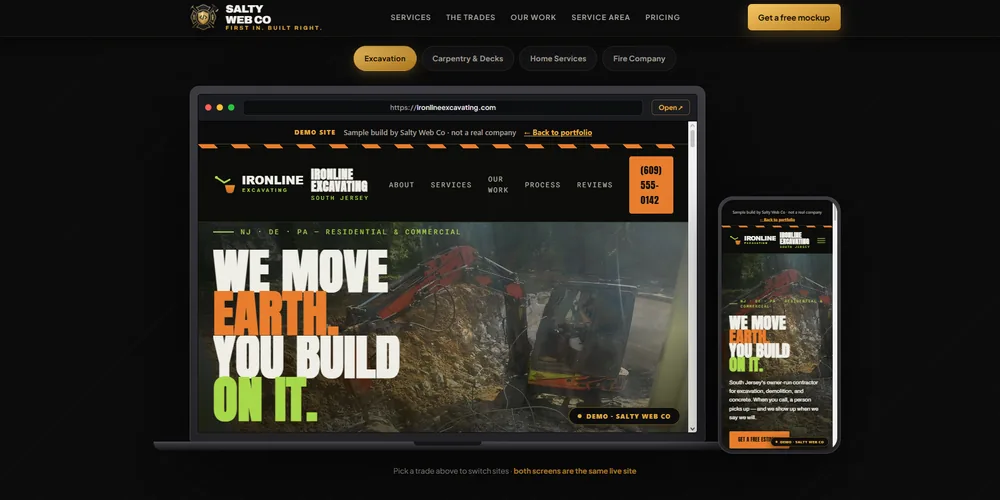
Being straight about what this is. The excavation site below is a demo, built to show the layout — the company in it is invented and labelled as such on every screen. Our live client work is Creative Concrete Company in Palatine, a different trade at the same standard. We would rather show you a demo we made and say so than borrow a real contractor's name we have not earned.
What is in the demo
- Homeowner and builder paths split from the first screen, so neither audience has to read the other's pitch.
- An equipment section that lists machines the way a PM reads them, rather than as decoration.
- Service pages by symptom — drainage, grading, demolition, foundations — because that is how homeowners search.
- A bid route that accepts real drawings, kept separate from the homeowner quote form.
- Click-to-call everywhere, and a layout that stays readable on a phone in a truck.
Want yours instead of the demo? We will build a real homepage for your company, with your machines and your jobs in it, before you pay anything.
Know the number before we roll.
Every project starts with a free mockup, and every build splits 50/50 — half to start, half when you are live. Nothing hourly, nothing hidden.
The Attack Line
Single-page site · $500 to start, $500 at launch
- Custom one-page site, mobile first
- Job gallery and click-to-call
- Quote form that never loses a lead
- Google Business Profile setup
- Rush launch in 24–72 hours available
Working Fire
Up to 5 pages · $1,250 to start, $1,250 at launch
- Everything in The Attack Line
- Separate homeowner and builder paths
- Equipment page with real specifications
- Service pages — drainage, grading, demo, septic
- English + Spanish toggle
- 30 days of free post-launch edits
Second Alarm
8–10 pages · $2,250 to start, $2,250 at launch
- Everything in Working Fire, expanded
- Every old URL mapped and redirected — nothing 404s
- Search Console baseline, before and after
- Google Business Profile optimised, not just switched on
- Schema markup and local SEO foundation
- Search & Rescue migration included free
Keeping it running afterwards is optional and month-to-month: Standing Watch at $49/month covers hosting, backups, security and content edits. Running Calls at $149/month adds monthly Google Business Profile posts, review requests, a seasonal service page each quarter and the numbers on what the site produced. Cancel either any time — you own the site regardless.
Questions excavators actually ask us.
How much does an excavation company website cost?
Most of our work comes from builders and GCs, not homeowners. Does a website still help?
Can the site take plans and specs, not just a contact form?
Should we put our equipment on the site?
Salty Web Co
Round Lake, IL 60073
(224) 225-9268
[email protected]
saltywebco.com
Where we work
Excavation and site work contractors across Lake County, McHenry County and the northwest Chicago suburbs — Round Lake, Grayslake, Mundelein, Libertyville, Gurnee, Antioch, Wauconda, McHenry, Crystal Lake, Woodstock, Barrington and the towns between them. Everything we build is remote-friendly, so if you dig outside that ring we can still do the work.
See it before you pay a dime.
We build a real homepage design for your excavation company and show it to you first. Like it and we finish the job. Don't and you owe us nothing.
Get my free mockup